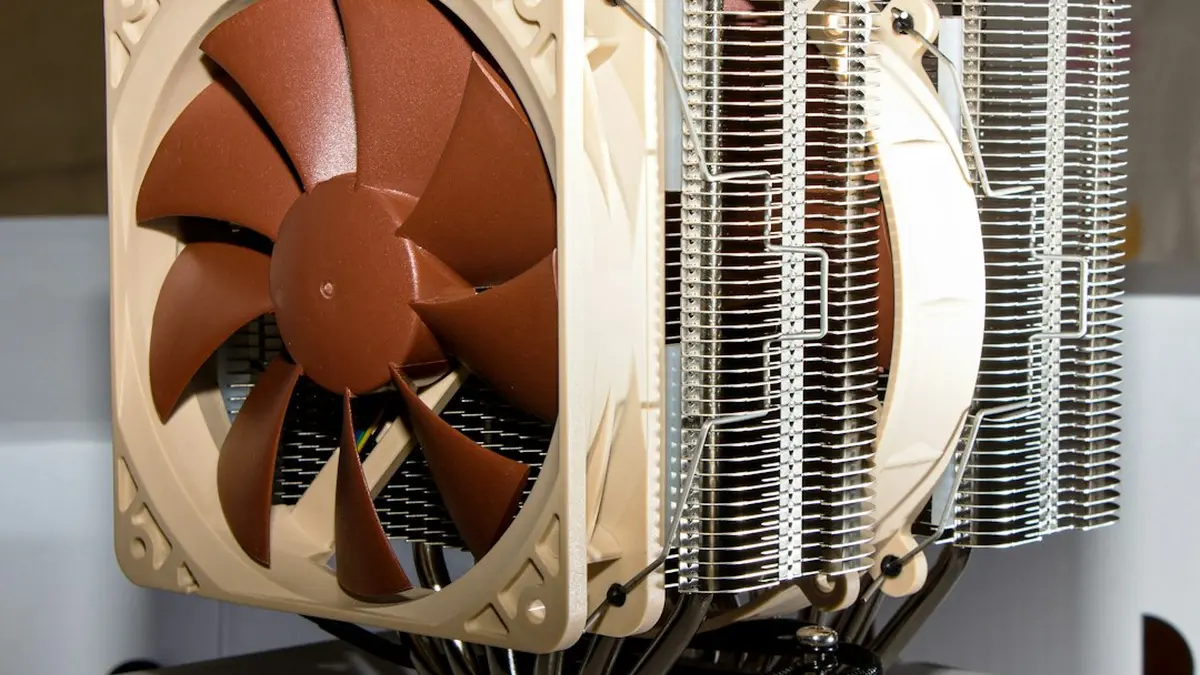
For most builds in November 2026, the best CPU fan cooler is Thermalright's Peerless Assassin 120 SE. Tom's Hardware's CPU cooler guide lists it at about $36 and names it the pick for most people. It wins on one measure that is worth understanding before you spend more: how much heat a cooler moves at a fixed noise level.
You will see that measure every time two coolers are compared. It is why a $36 tower can sit next to a $150 Noctua on a chart. It is why a "250W TDP" figure on a box tells you very little. And it decides whether your chip needs a bigger tower, a 360mm AIO, or neither. Below: how the measure works, which coolers do well on it and at what price, which CPUs actually need more, and what to check before you order. Benchmark Extreme tests nothing itself. Every figure here belongs to the publication that measured it, and figures from different reviewers are never ranked against each other as if they came from one test.
How a cooler earns the word best
Turn up the fans and any air cooler gets cooler and louder at once. That makes a chart run at 100% fan speed a contest won by whoever ships the most aggressive fan. The fair comparison fixes the noise and lets temperature vary. Gamers Nexus calls this noise-normalized testing. It adjusts each cooler's fan speed until the rig hits a set sound level, then records the CPU's temperature at steady state.
Gamers Nexus explains its method on its CPU cooler Mega Charts page, last updated August 4, 2026:
- The noise target. Its 2026 tests run at 25 dBA inside a hemi-anechoic chamber. The older AMD bench used 35 dBA in a normal room, which had a noise floor of about 26 to 27 dBA.
- The heat load. The new charts use an overclocked Ryzen 7 9800X3D at about 157W and an overclocked Ryzen 9 9950X3D at about 276W. The legacy Intel chart uses a 14900KF at about 250W.
- The result. Each score is delta T: degrees above a controlled 21°C room, read through HWiNFO64 and a calibrated K-type thermocouple. Power is measured at the EPS12V rail with a clamp meter, so the wattage is what the CPU actually drew, not what the box claims.
Gamers Nexus treats the noise-normalized chart as its main result and the 100% chart as extra information. Tom's Hardware reports differently. It gives the wattage a cooler kept up with on a named CPU, plus decibels at stated fan speeds. Both approaches are useful. Neither can be converted into the other.
The Mega Charts page also notes that CPU power drops by about 4% for every 10°C of temperature reduction. So a better cooler slightly lowers the load it has to handle. It also warns that its current rankings come from AMD sockets. IHS shape, chiplet layout and mounting hardware differ enough that LGA1700 or LGA1851 results "could rank differently". That warning is the most useful sentence on the page and also the least read.
Where the picks land, with their numbers
Best overall air: Thermalright Peerless Assassin 120 SE, about $36. Tom's Hardware (guide shown as updated November 6, 2026, though parts of the page date back to June 2026 and earlier) reports that it cooled a Core i9-12900K drawing over 200W better than competitors it tested. Noise was 34.5 dB at maximum fan speed and 33 dB at 50%. That makes it the quiet pick as well, because no other air cooler in our sources has a dB figure at a stated fan speed. Tom's deal coverage places it in AM5 and LGA1851/1700 builds. PC Gamer's roundup cites a height of 155mm and notes that at least one reviewer flagged possible interference with RAM. For the current price, check Amazon.
The brief says Gamers Nexus put this cooler ahead of the original NH-D15. That needs a qualification. Gamers Nexus reviewed the Peerless Assassin 120, not the SE, when its MSRP was $40 to $45 (the review unit cost about $41). The SE is the cheaper revision Tom's recommends. They are close relatives, but they are not the same SKU, and nobody in our sources has run the SE through the Gamers Nexus bench. With that understood, here is what the original review found:
- At 198W and 35 dBA: 56.4°C over ambient, tied for the best air cooler Gamers Nexus had tested at the time and within margin of error of the DeepCool AK620. It was 3.5°C ahead of the Scythe FUMA 2.
- At full fan speed against the original Noctua NH-D15: 1.8°C cooler and 1.6 dBA quieter.
Mid-size and quiet: Scythe Mugen 6, often about $40 on sale. Tom's names it best mid-size and praises how quietly it runs. Our sources have no dB figure, socket list or height for it, so its quiet reputation is a description, not a number.
Big air for 250W-class chips: Thermalright Royal Pretor 130, $52.90 MSRP. Tom's labels it best big air cooler. At 23°C ambient it handled over 259W on a Core i7-14700K and over 254W on a Ryzen 9 9950X3D. Supported sockets: Intel LGA1851, 1700, 1200 and 115x, and AMD AM5 and AM4. The Peerless Assassin 120 SE usually costs $15 to $20 less, which tells you what the extra headroom costs.
Premium: Noctua NH-D15 G2, $149.95 MSRP. Tom's Hardware's review is headlined "Not worth $150", and the body backs the headline up. The cooler averaged about 240W in Tom's torture test, roughly 10W more than the original NH-D15, and ran up to 3°C cooler. It is also one of the few air coolers that did not throttle in Tom's no-power-limit test. In the same comparison, Arctic's Liquid Freezer III 360 throttled. Gamers Nexus's awards roundup (last updated November 26, 2025) gave it best noise-normalized air thermals and best mechanical design. The HBC variant scored 52.5°C over ambient on the 250W Intel test. The value problem is real: APH Networks reported its price climbing from $150 to $180 because of tariffs. Height is about 168mm by Noctua's spec, and one source says 164mm. Reviewers suggest raising the front fan or running a single fan to clear tall RAM.
Budget, under the Peerless. The Peerless itself sits at the top of a $35 to $40 budget. Below it, Gamers Nexus's roundup has the Arctic Freezer 36 at about $28. It tied with the ID-Cooling A720 for best overall on the Intel-only bench, and PC Gamer also chose it as its budget air pick. Gamers Nexus's best-budget award went to the ID-Cooling SE-214-XT ARGB at $15.19, which logged 37.9 dBA on the 123W AM4 test. The same roundup shows what you give up at that price: 60.6°C over ambient at 200W on the 14900KF at full fan, the worst result on that chart. Tom's entry-level pick, the Thermalright Assassin X 120 R SE, comes with a one-year warranty and is not recommended for overclocking.
Fanless: Noctua NH-P1, $119. Tom's notes a six-year warranty, says it needs good case airflow, and says it mounts in only one orientation on AMD boards.
Low-profile / small form factor. None of our sources gives a low-profile air cooler with a height in millimeters. Gamers Nexus charts a Peerless Assassin Mini, but our notes have no height or result for it. We would rather leave that slot empty than fill it from memory.
Best AIO: Arctic Liquid Freezer III Pro 360, $125 MSRP. This is a 360mm radiator. Tom's calls it the best AIO it has tested for low CPU temperatures if you don't need RGB or a screen. It supports LGA1851, LGA1700, AM5 and AM4, and needs at least 63mm of clearance for radiator plus fan thickness. For the street price, check Amazon. The non-Pro Liquid Freezer III won Gamers Nexus's noise-normalized thermals outright, at 46.7°C over ambient on the 200W AMD test, and its 360mm version measured 39.8 dBA at 100% fan on the 250W Intel test.
| Cooler | Type | Price (as listed by source) | Sockets (per source) | Height / clearance | Warranty | Role (source) |
|---|---|---|---|---|---|---|
| Thermalright Peerless Assassin 120 SE | Air | ~$36 | AM5, LGA1851/1700 | 155mm | Not in sources | Best for most (Tom's) |
| Arctic Freezer 36 | Air | ~$28 | Not in sources | Not in sources | Not in sources | Tied best overall, Intel bench (GN) |
| ID-Cooling SE-214-XT ARGB | Air | $15.19 | Not in sources | Not in sources | Not in sources | Best budget (GN) |
| Scythe Mugen 6 | Air | ~$40 on sale | Not in sources | Not in sources | Not in sources | Best mid-size (Tom's) |
| Thermalright Phantom Spirit 120 EVO | Air | $46.90 | AM5, LGA1851 | 157mm | Not in sources | Budget option (PC Gamer roundup) |
| Thermalright Royal Pretor 130 | Air | $52.90 MSRP | LGA1851/1700/1200/115x, AM5/AM4 | Not in sources | Not in sources | Best big air (Tom's) |
| ID-Cooling A720 | Air | ~$55 | Not in sources | Not in sources | Not in sources | Best overall 2024 award (GN) |
| Noctua NH-U12S | Air | $60 to $69 | AM5, LGA1851 | Not in sources | Not in sources | Mainstream pick (PC Gamer roundup) |
| Noctua NH-P1 | Passive air | $119 | AMD: one orientation only | Not in sources | 6 years | Best fanless (Tom's) |
| Noctua NH-D15 G2 | Air | $149.95 MSRP; $180 after tariffs (APH) | Not in sources | ~168mm (Noctua spec) | Not in sources | Premium; best NN air thermals (GN) |
| Thermalright Frozen Prism 360 | 360mm AIO | $52.71 | Not in sources | Not in sources | Not in sources | Best value (GN) |
| MSI MPG Coreliquid P22 360 | 360mm AIO | $99 | Not in sources | Not in sources | Not in sources | Tom's guide |
| Arctic Liquid Freezer III Pro 360 | 360mm AIO | $125 MSRP | LGA1851/1700, AM5/AM4 | 63mm radiator clearance | Not in sources | Best AIO for low temps (Tom's) |
Fan count, airflow (CFM) and static pressure are not in the material this piece draws on, for any of these coolers. Check them on the manufacturer's spec page rather than trust a retailer listing. Prices are what each source printed on its date, not what you will pay today.
Temperature against noise, source by source
Read this table one source at a time. A Gamers Nexus delta T and a Tom's Hardware wattage come from different rigs, ambient temperatures and CPUs. Tom's also warns that its own entries were tested on different platforms and shouldn't be ranked head to head.
| Source and date | Cooler | Load / condition | Temperature | Noise |
|---|---|---|---|---|
| Gamers Nexus PA120 review | Peerless Assassin 120 (not SE) | 198W, noise-normalized | 56.4°C over ambient | 35 dBA |
| Gamers Nexus PA120 review | Peerless Assassin 120 | 198W, 100% fan | 53.4°C over ambient | 42.5 dBA |
| Gamers Nexus PA120 review | Peerless Assassin 120 | 123W, noise-normalized | 54.1°C over ambient | 35 dBA |
| Gamers Nexus PA120 review | Peerless Assassin 120 | 123W, 100% fan | 52.1°C over ambient | 42.3 dBA |
| Gamers Nexus roundup, Nov 26 2025 | ID-Cooling A720 | 200W AMD, noise-normalized | 55.2°C over ambient | Normalized |
| Gamers Nexus roundup, Nov 26 2025 | Noctua NH-D15 G2 HBC | 250W Intel | 52.5°C over ambient | Not given |
| Gamers Nexus roundup, Nov 26 2025 | Arctic Liquid Freezer III | 200W AMD, noise-normalized | 46.7°C over ambient | Normalized |
| Gamers Nexus roundup, Nov 26 2025 | Thermalright Frozen Prism 360 | 200W AMD, noise-normalized / 250W Intel 100% | 49.7°C over ambient | 53.2 dBA at 100% |
| Gamers Nexus roundup, Nov 26 2025 | ID-Cooling SE-214-XT ARGB | 200W 14900KF, 100% fan | 60.6°C over ambient | 37.9 dBA (123W AM4 test) |
| Tom's Hardware guide, Nov 2026 | Peerless Assassin 120 SE | i9-12900K, over 200W | Not given as °C | 33 dB at 50%, 34.5 dB at max |
| Tom's Hardware guide, Nov 2026 | ID-Cooling FX360 INF (~$80 AIO) | Heavy gaming / max fan | Not given | 40.9 / 44.4 dBA |
| Tom's Hardware guide, Nov 2026 | Silverstone IceMyst 360 vs 240 | Matched 38.2 dBA | 237W vs 228W dissipated | 38.2 dBA |
Two patterns come through. First, the gap between good air coolers is about a degree. Gamers Nexus has the A720 roughly 1°C ahead of the Peerless Assassin 120 on AMD and 1.6°C ahead on Intel. A degree is real, but it is not worth $100. Second, the cheap AIO is not the quiet AIO: the Frozen Prism's 53.2 dBA at full fan is 13.4 dBA louder than the Liquid Freezer III 360 on the same Gamers Nexus test. A low price on a radiator often means a loud fan bolted to it.
Not the number on the box
A TDP rating printed on a cooler's box is not cooling capacity. It is the vendor's claim, with no stated ambient temperature, noise level or CPU. The figures that mean something are the ones above: watts held on a named chip at a stated ambient, or degrees over ambient at a fixed dBA. Verifying a box rating would take exactly that kind of test, so use the tests.
A higher score at 100% fan speed is also not a better cooler. It is a louder fan. That is why Gamers Nexus gives the noise-normalized chart top billing.
Air versus AIO is not about prestige either. It comes down to sustained wattage, clearance and noise:
- Air is enough when the CPU's sustained draw sits within what the cooler has been shown to handle. For the Peerless Assassin 120 SE, that is the 200W-plus result above. Air needs side-panel clearance for its height (155mm for the Peerless, about 168mm for the NH-D15 G2) and room around the RAM.
- An AIO is worth it when the chip runs past about 250W with no power limits, or when a tall tower won't fit but the case has a radiator mount with 63mm of depth. Even then, the NH-D15 G2 avoided throttling in a test where a 360mm Liquid Freezer III did not. Liquid is not automatically more headroom.
Which chips need the bigger tower
The question is sustained watts, not core count.
- Ryzen 7 9800X3D and other X3D eight-cores. Gamers Nexus's 2026 bench pushes an overclocked 9800X3D to only about 157W. Gamers Nexus measured the original Peerless Assassin 120 at 198W on its older bench and got a competitive result. That is a different rig, so treat it as a strong hint rather than a direct comparison: on that evidence, a $36 cooler is plenty for this class of chip.
- Ryzen 9 9950X3D. Gamers Nexus overclocked it to about 276W. Tom's ran the Royal Pretor 130 at over 254W on this chip. Buy the bigger tower or a 360mm AIO here, especially if you will remove power limits.
- Core i9-14900K. Gamers Nexus's legacy Intel chart loads the 14900KF at about 250W. That is NH-D15 G2 or Royal Pretor territory, or a 360mm AIO.
- Core Ultra 200-series (Core Ultra 9 285K, Core Ultra 7 265K, Core Ultra 5 245K). Tom's lists the 285K among its test platforms, but our sources include no cooler result or power figure for it. Gamers Nexus also cautions that its AM-socket rankings may not carry over to LGA1851. Our default is the same: the 245K and 265K on a Peerless-class tower, the 285K with no power limits on big air. But that rests on reasoning, not a published LGA1851 result.
To see where these chips sit on performance, the processors table has the sourced benchmarks.
AMD Ryzen 7 9800X3D
- Geekbench 6 CPU Single-core 2,968 points Geekbench Browser, Sep 16, 2026
- Geekbench 6 CPU Multi-core 18,740 points Geekbench Browser, Sep 16, 2026
AMD Ryzen 9 9950X3D
- Geekbench 6 CPU Single-core 3,058 points Geekbench Browser, Sep 16, 2026
- Geekbench 6 CPU Multi-core 26,572 points Geekbench Browser, Sep 16, 2026
Intel Core i9-14900K
- Geekbench 6 CPU Single-core 2,661 points Geekbench Browser, Sep 16, 2026
- Geekbench 6 CPU Multi-core 21,933 points Geekbench Browser, Sep 16, 2026
Intel Core Ultra 9 285K
- Geekbench 6 CPU Single-core 2,832 points Geekbench Browser, Sep 16, 2026
- Geekbench 6 CPU Multi-core 25,837 points Geekbench Browser, Sep 16, 2026
Fit check before you order
None of the page-one guides gives a fit checker, so here is one built only from what the sources state. Go through it in order. Each step is the one that sends coolers back to the store.
-
Socket listed on the box, not just in a review
Royal Pretor 130 and Liquid Freezer III Pro 360 list LGA1851, LGA1700 and AM5. Phantom Spirit 120 EVO and NH-U12S list AM5 and LGA1851. For the original Peerless Assassin 120, Gamers Nexus found that LGA1700 owners might need a separately sold mounting kit of about $9.
-
Socket you will own next year
Intel is moving desktop chips to a new socket with a different loading mechanism, so check whether your cooler's maker will ship a kit before you assume an LGA1851 cooler carries over.
-
Side-panel clearance against cooler height
155mm (Peerless Assassin 120 SE), 157mm (Phantom Spirit 120 EVO), about 168mm (NH-D15 G2). Your case's maximum cooler height is on its spec sheet.
-
RAM and VRM heatsink clearance
Tall DIMMs collide with front fans. The Peerless has been flagged for this, and the NH-D15 G2 may need its fan raised or removed.
-
Radiator depth and length for an AIO
The Liquid Freezer III Pro 360 needs at least 63mm. Tom's says to check both thickness and length.
-
Case airflow for a passive or big tower
The NH-P1 needs good case airflow, and so does any tower that relies on case fans to remove the heat.
-
Mounting orientation on AMD
The NH-P1 mounts in only one direction on AMD boards, which may point its fins the wrong way for your case's airflow path.
The socket change is covered in detail in our piece on Intel's new LGA1954 socket. For the airflow step, see how to judge case airflow without trusting a "high airflow" label.
Verdict by budget
Under $30: Arctic Freezer 36 (~$28 per Gamers Nexus) for anything up to a mainstream six- or eight-core. The ID-Cooling SE-214-XT ARGB at $15.19 is a stock-cooler replacement, not a high-load cooler, and its 200W Intel result shows it.
$30 to $40, the right answer for most people: Thermalright Peerless Assassin 120 SE. It has the most documented performance per dollar of any cooler here, plus a measured 33 to 34.5 dB from Tom's. Choose the Scythe Mugen 6 instead if you need a mid-size tower and value quiet over measured figures.
About $50: Royal Pretor 130, if your CPU is a Ryzen 9 9950X3D, a Core i9-14900K or an unlocked Core Ultra 9 that you run without power limits.
$150 and up: Noctua NH-D15 G2, only if you want the best noise-normalized air result Gamers Nexus has recorded and you value Noctua's build quality. As TechRepublic (October 2026) summarized the Gamers Nexus findings: "Its weakness is value, since cheaper coolers can get close."
Liquid: Arctic Liquid Freezer III Pro 360 at $125 MSRP, where a tower won't fit or a no-limits flagship needs the extra radiator area.
The Cooler Master Hyper 212: this is the cooler most buyers will find on a Best Buy shelf. Gamers Nexus's Mega Charts include the Hyper 212 RGB, but our sources contain neither a dated Best Buy price for the Hyper 212 line nor a thermal figure for it. Until we have both, we have no verdict on it. If you are standing in the aisle, the Peerless Assassin 120 SE's sourced results are the benchmark it has to beat on price.
Weighing an AIO against air for a specific chip?
The broader cooler guide covers both types, matched to what current CPUs actually draw.
Read the best CPU cooler guide
Comments
No comments yet. Be the first to comment!
Leave a Comment